


In this blog, we explain how best to combine scents and perceive them effectively. To perceive a scent well in the sauna, it is important to consider the scent tone and strength. Read this blog to learn when all scents come out at their best. When pouring, it is helpful to start with a scent with low strength. If you do not have a scent with low strength, you can also start with a top note scent. Next, a middle note scent can be used, followed by a base note. Below is an overview of the top note, middle note, and base note scents. We have also added an overview of the strengths of our scents.
Scent Notes
in aromatherapy
There are top notes, middle notes, and base note scents. These are closely monitored when developing a perfume. A good perfume contains a top note, a middle note, and a base note. Ylang Ylang oil is the only essential oil that contains all three of these notes in a single essential oil.

- The top note emerges first and is also the first to disappear.
- The middle note emerges after the top note and lingers a little longer.
- The base note emerges last and lingers the longest.
When combining these three notes, use a fragrance stick or a cotton swab and place them together in a sachet. Place this sachet on the heater so that the scents mix a little, and then smell the sachet to see if this is the scent you want to achieve. If it is not yet the scent you would like, add another scent or use a little more of the scent you want to make stand out more.
Top notes = appear first but also disappear first
Pineapple – Bergamot – Blood Orange – Lemon – Citrus Fruit – Eucalyptus – Eucalyptus Mint – Eumiment – Fresh Linen – Fresh Water – Chestnut – Spearmint – Spring – Lime – Litsea Cubeba – Lotus – Mandarin – Mint Fresh – Mint – Peppermint – Orange – Tea Tree – Fig – Wintergreen – Summer –

Middle tones = comes forward after the overtone and lingers a little longer
Bamboo – Caldarium – Pine – Green Apples – Green Tea – Hammam – Harmony – Honey Melon – Intense – Cinnamon – Clove – Lavandin – Lavender – Lemongrass – Linden Blossom – Magic – Ocean – Orange Blossom – Oregano – Red Apple – Rosemary – Sauna Gold – Orange Honey – Spa – Fir – Sport – Ylang Ylang – Seaweed – Sweet Rhubarb – Black Pepper –
Undertones = comes forward after the midtone and lingers the longest
Alpine Herbs – Almond Blossom – Amber – Birch – Cedarwood – Flora – Autumn – Honey – Myrrh – Opium – Oriental – Passionflower – Patchouli – Roses – Sandalwood – Tantra – Vanilla – Winter –

Fazit
Roughly speaking, it can therefore be said that the citrus scents belong to the top notes, and the floral and herbal/spice scents to the middle notes and the wood and resin scents to the base notes. Check the essential oil blending chart to see if certain scents go well together. On the next page, all our top notes, middle notes, and base notes are listed, subdivided by scent.
Scent sequence
It is important to consider the pitches when adjusting the scent sequence. When a base note has just been used, a top note cannot overpower this scent. Would you still like to use a base note first and then a top note? Then use Pine or a citrus scent in between, such as Lemon, Orange, etc., to neutralize the scent. A citrus scent is present for a moment itself but also absorbs the other scent. However, do not use Lemongrass, as this scent is a middle note itself and will therefore only perpetuate the problem.
Duftfamilien
in essential oils, perfumes, and sauna infusions
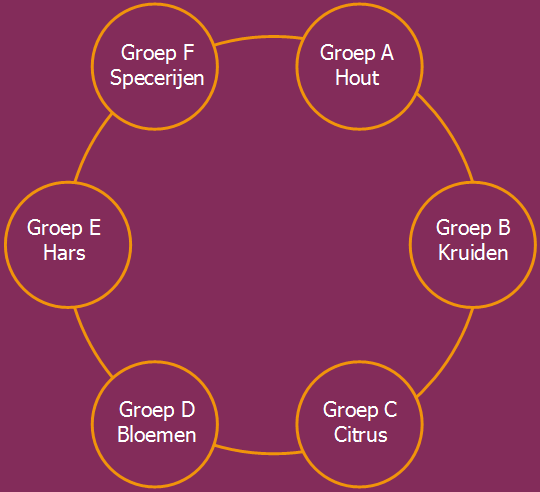
In addition to scent strengths and scent notes, there are also scent groups. There are only 6 groups of essential oils, which are: Group A – Wood, Group B – Herbs, Group C – Citrus, Group D – Floral, Group E – Resin, Group F – Spices. In addition, we also have a group that only occurs in perfume scents; this is Group G – Fruit. And we also have a Group H – Fantasy. This is the group containing the remaining scents that do not have a destination in the other groups. The scent groups we have distinguished are:
- Holz
- Kräuter
- Zitrussfrucht
- Blumen
- Harz
- Gewürze
- Frucht
- Fantasie
There are only 6 groups of essential oils, which are these:
Group A Wood
Bamboo – Cedarwood – Pine Eucalyptus – Sandalwood Fir – Tea Tree
Group B Herbs
Caldarium – Dill – Green Tea Spearmint – Lavender Mint – Oregano – Patchouli Peppermint – Rosemary Sport – Wintergreen
Group C Citrus
Bergamot – Blood orange – Lemon – Citrusfruit Lemongrass – Lime – Litsea Cubeba Mandarin – Orange (sweet)
Group D Flowers
Flora – Geranium Linden blossom – Lotus – Orange blossom Palmarosa – Roses – Ylang Ylang
Group E Resin
Amber – Myrrh Opium – Oudh
Group F Spices
Cinnamon – Clove – Vanilla – Black Pepper
Group G Fruit
Pineapple – Green Apples – Honey Melon Red Apple – Fig
Group H Fantasy
Alpine Herbs – Almond Blossom – Buddha Citrus & Spice – Eucalyptus Mint Eumiment – Fresh Linen Fresh Water – Hammam Harmony – Autumn – Honey Intense – Chestnut – Cucumber Lemonmint – Spring – Magic – Me Time Mint Fresh – Ocean Oriental – Sauna Gold – Orange Honey Spa – Tantra – Winter Seaweed – Sweet Rhubarb – Summer Fragrances from the same fragrance group can always be combined well with each other. Thus, Orange, Lemon, and Mandarin can be combined well. Eucalyptus can also be combined well with Pine and Cedarwood. Additionally, it is possible to create the following combinations: – woody scents with herbs An example of this is: Eucalyptus with Mint – citrus scents with herbs or flowers An example of this is: Orange with Lavender and Roses – resin scents with flowers or spices An example of this is: Amber with Rose Musk and Vanilla When composing scents, one can start from known combinations. By this, we mean a combination that we know from, for example, our food (such as Green Apple with Cinnamon). This often gives an idea of how a scent can be combined. Be careful not to start with too many different scents. If you are going to start combining scents, start with 2 different ones and only expand later. The more scents are used together, the more difficult it is to find a balance. It is important when combining that all scents in the mixture are noticeable. Always test your combination scent during a quiet moment in the sauna. Even if the combination scent smells fine while it is cold, every scent reacts differently when heated. Tip for adding the scent to the sauna bucket: always mix the scent in a sauna bucket beforehand. Do this just before the start of the session so that the scent cannot have evaporated before use. Some sauna masters prepare the scent in the morning to use in the afternoon. In this case, there is a chance that part of the scent will have evaporated before use.
Scent strengths
when using essential oils, perfumes, and sauna infusion liquid
The scent strengths are listed under the selection menu on the webshop. From this, you can deduce whether a scent is strong or weak when combined with another scent. Fragrance strength 1 is the weakest and fragrance strength 6 is the strongest. Therefore, when combining multiple fragrances, use a little less of fragrance strength 5 or 6 and a little more of fragrance strength 1 or 2. When building up in a pour-over, it is also preferable not to use fragrance strength 6 at the beginning and then fragrance strength 3. Or use less of fragrance strength 6 for the first fragrance and dose the second fragrance normally.
1. Fragrance strengths of essential oil, essential oil mix, and perfume
Fragrance strength 2 = moderate: 1.75 ml per 1 liter of water. (35 drops per 1 liter of water)
Caldarium – Mandarin Ocean – Petit Grain Tea Tree – Fig
Fragrance strength 3 = strong: 1.5 ml per 1 liter of water. (30 drops per 1 liter of water)
Bergamot – Blood Orange Lemon – Citrus & Spice – Citrus Fruit – Pine Eucalyptus – Eucalyptus Mint – Fir – Flora – Fresh Linen Green Tea – Autumn – Honey-Melon Chestnut – Spearmint – Lavandin – Lavender Spring – Linden Blossom – Litsea Cubeba Lotus – Magic – Mint – Orange Blossom Oregano – Oriental – Peppermint Rosemary – Sauna Gold Orange – Spa – Sport Summer – Black Pepper
Fragrance strength 4 = stronger: 1.25 ml per 1 liter of water. (25 drops per 1 liter of water)
Bamboo – Buddha – Cedarwood Eumiment – Green Apples Hamam – Lemongrass – Lemonmint Lime – Mint Fresh – Opium Patchouli – Red Apple – Roses Orange Honey – Ylang Ylang – Seaweed
Fragrance strength 5 = very strong: 1 ml per 1 liter of water. (20 drops per 1 liter of water)
Alpine Herbs – Almond Blossom – Amber Pineapple – Honey – Cinnamon Clove – Myrrh – Sandalwood – Vanilla Winter – Wintergreen – Sweet Rhubarb
2. Fragrance strengths of Sauna aroma’s
Fragrance strength 2 = moderate: 6.25 ml per 1 liter of water.
Caldarium – Mandarin Ocean – Oregano – Petit Grain Tea Tree – Fig – Black Pepper
Fragrance strength 3 = strong: 5 ml. per 1 liter of water.
Bergamot – Blood Orange Lemon – Citrus Fruit – Pine – Eucalyptus – Eucalyptus Mint Fir – Fresh Linen – Green Tea Autumn – Honey-Melon – Cinnamon Chestnut – Clove – Spearmint Lavender – Spring – Lime – Linden Blossom – Litsea Cubeba Lotus – Magic – Mint – Orange Blossom Oriental – Peppermint – Rosemary – Sauna Gold Orange – Spa – Sport – Summer
Fragrance strength 4 = stronger: 3.75 ml. per 1 liter of water.
Bamboo – Buddha – Cedarwood – Eumiment – Flora Green Apples – Hamam – Harmony Intense – Lemongrass – Opium – Patchouli Red Apple – Roses – Orange Honey Ylang Ylang – Seaweed
Fragrance strength 5 = very strong: 2.5 ml per 1 liter of water.
Alpine Herbs – Almond Blossom – Amber – Pineapple Honey – Mint Fresh – Myrrh – Sandalwood Tantra – Vanilla – Winter – Wintergreen – Sweet Rhubarb
Fragrance combination tip:
It is helpful to combine only two to three fragrances at the beginning. If you start combining more fragrances at once, the result can turn out much less pleasant. If you take the above methods into account, things usually turn out fine. If combining isn’t really your thing, choose from a few of our 110 delicious fragrances.